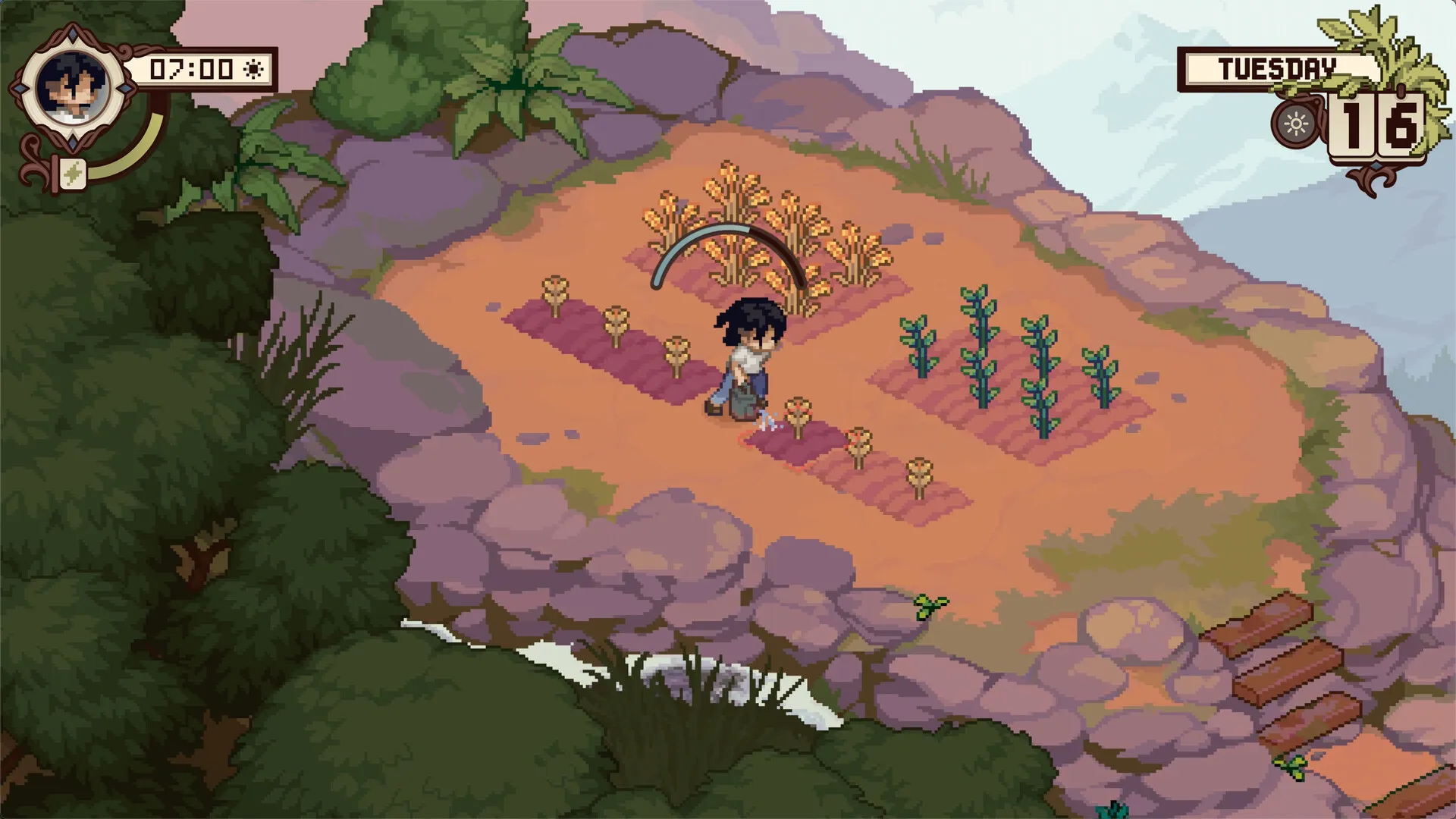
Your mountainside farm
The farm sits above Ashenridge. Different farm plots, seasonal crops and aesthetic customization are announced, but exact crop calendars and harvest profits have not been tested here.
Tools and the farming interaction
The farming development log describes a shovel for preparing ground, seeds selected from the quick inventory and a watering can for newly planted ground. A pickaxe supports mining and an axe handles trees. The visible farming grid marks possible interactions; tool choice, energy and plot compatibility affect whether an action is allowed.
- Prepare the plot with the shovel.
- Select compatible seeds from the quick inventory.
- Water where the plot type requires it.
- Read the seed information for season and plot conditions.
Three plot types
The development log distinguishes dry elevated ground, regular soil and wet ground near the river. The farm area is limited, and the plot types are not described as expandable. Match a crop to the information supplied by the game instead of assuming all soil behaves the same.
Arid
Dry, elevated ground for certain crops
No verified crop-by-crop list here
Regular
The most common growing space
Available space is not an unlimited expansion
Wet
River-growing crops do not need watering
This is not proof of faster growth or higher profit
Official development information. Sources: Devlog: Farming Systems & Grids
How farm activities connect to the wider game
Farming is part of the mystery’s resource loop, not a separate promise of an optimal money route. See investigation mechanics for consequences, characters for relationship scope and locations for the seven announced areas.
| System or area | Official description | What this means / limits |
|---|---|---|
| Seasonal crops | Different farm plot types support seasonal crops. | Crop calendars, seed costs and yields need direct evidence. |
| Kitchen and shed | Both are described as places to craft recipes. | A recipe cannot be assigned to a station without confirmation. |
| Occult crafting | Some crafted items may help protect potential victims. | Exact recipes and story solutions are omitted from this spoiler-aware overview. |
| Tools and buildings | Upgrades and some aesthetic choices are announced. | No profitable upgrade order is claimed. |
| Foraging and harvest | Farm work and gathering can uncover town history. | Specific discoveries depend on verified campaign conditions. |
Official description, not a hands-on test. Sources: Grave Seasons on Steam
Crafting has two roles
Recipes can support everyday farm life or the investigation. Kitchen, shed and occult crafting should not be collapsed into an invented single workstation tree. Ingredient counts need their own evidence.
Time and consequences
The narrative takes place over a year, with decisions checked and autosaved according to the official description. That does not establish the length of a day or season in real time. Farming schedules must be measured in the actual build.
Seasons and seed information
The developers describe spring, summer, autumn and winter within the game’s year. Seed information identifies seasonal and plot requirements; seeds may be bought or found while foraging. That supports checking the seed record before planting, but not an invented planting calendar or profit ranking. Read day and night for the separate role of time within a day.
Growing the farm beyond a single harvest
The official description announces upgrades to tools and farm buildings, together with aesthetic choices. An upgrade can therefore change the farm’s facilities or appearance as well as the equipment you carry. The store does not publish costs or a mandatory order. Keep that progression separate from assumptions about expanding the limited plot areas described in the farming development log.
Sources & scope
Based on official information checked 2026-10-01. Announced features can change. This page does not claim first-hand gameplay testing.