
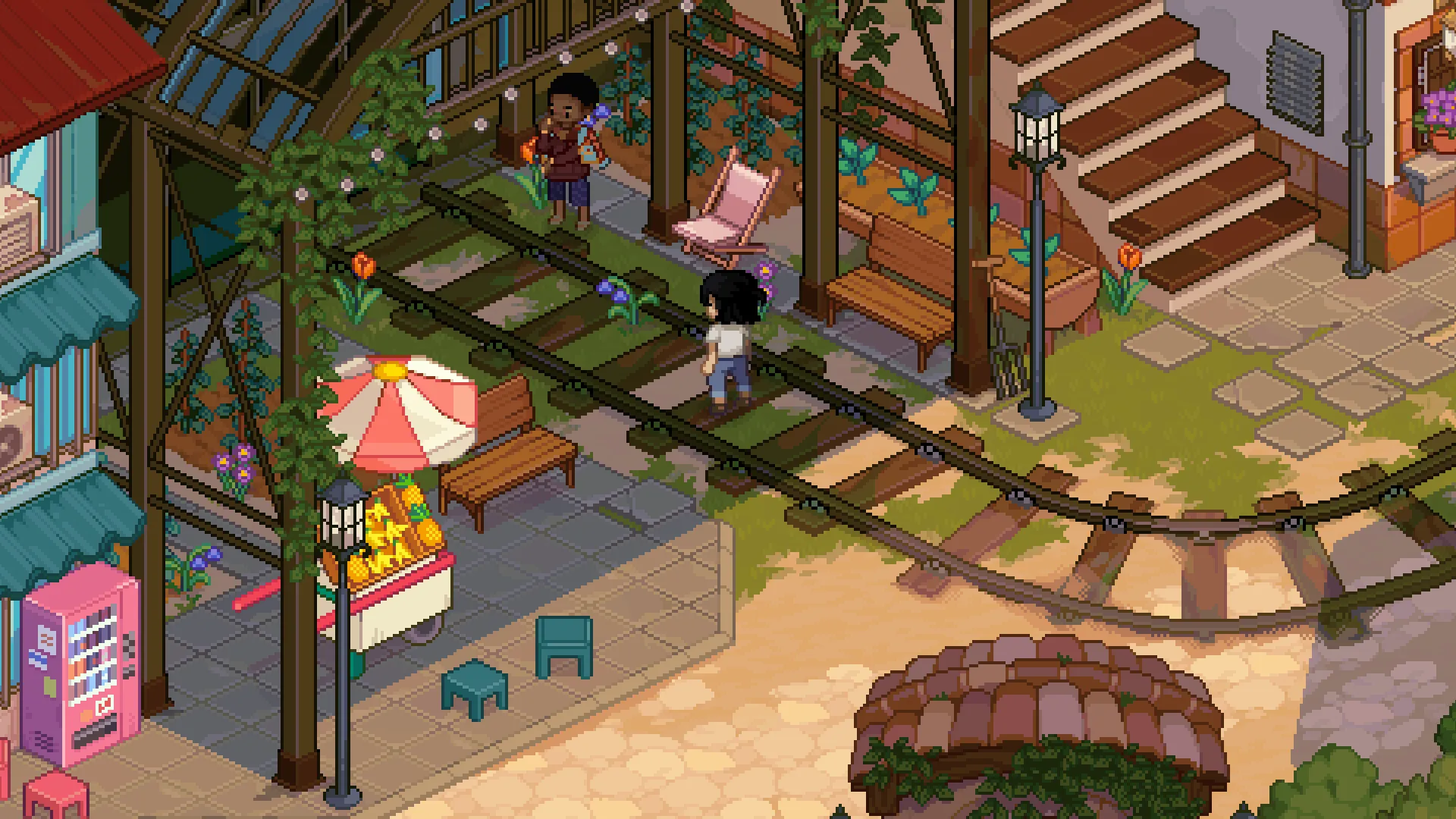
A new life in Ashenridge
Grave Seasons is an isometric pixel-art farming and life simulation from Perfect Garbage. You arrive in the mountainside town of Ashenridge and build a life around a farm, its residents and the surrounding countryside. Beneath that everyday routine is a supernatural murder mystery. The current Steam listing describes a single-player, narrative-driven game: your time in town matters both to your daily work and to the story.
The farm gives the day its rhythm
Your farm sits above town. Digging, planting and watering connect tools to seasonal seeds and different kinds of soil. The farming development log describes a visible grid that helps you select a nearby plot, while the choice of crop depends on both season and plot type. Gathering, fishing and mining broaden the daily loop beyond the farm. Start with the farming guide, then compare tools and plot types.
The town gives the routine its meaning
The current official description announces more than 30 residents and 12 potential romance options. Those are the size of the announced cast and relationship system, not a complete list of profiles available here. Conversations and relationships sit alongside exploration: people have places in the town, and the developers describe residents who may also be out after dark. The character directory introduces named people without turning public appearances into invented schedules.
One year, with room to explore after dark
The announced story takes place over one year, through spring, summer, autumn and winter. A day runs through a full 24-hour cycle. The developers deliberately avoided a universal nighttime boundary that simply stops exploration, but rest remains relevant to farm life. This makes the day and night cycle useful context for the whole game. A yearly narrative structure does not establish how many real-world hours a playthrough will take.
Investigation is part of the wider routine
Farming, foraging and crafting are described as contributing to the investigation, including finding materials and making items. The game also includes entering residents’ spaces with an unusual tool: a crowbar. This is a distinct announced activity, not evidence of a conventional weapons progression system. The investigation overview keeps additional campaign mechanics behind optional notes, while breaking and entering explains the public design history.
Choose a first reading path
If you want to understand the everyday game, read farming, characters and the world overview first. If you are deciding where or when to play, use the release page and platform overview. This guide describes announced mechanics; a reproducible opening-day walkthrough will require a playable version and recorded conditions.
- Everyday life: farming, tools, seasons and crafting.
- The town: residents, relationships and Ashenridge’s seven areas.
- The mystery: public investigation mechanics and optional deeper reading.
Sources & editorial scope
Sources checked 2026-10-06. This article covers official announcements, not a first-hand gameplay test. Older source material retains its original release context.